
Progress
Nyazen’s unique body type continues to give us a fun challenge as we work on their standard animations! Most recently, we’ve been blocking out a rough version of their “walk” animation (if you can call it that) to figure out what works best. Here’s a preview of the most recent version, where we’re experimenting with a contrast between up-and-down motion at the front of their body and a slight spiral motion for their tail. We’d love to hear your thoughts!
As part of our upgrade to the most recent version of Unity LTS, we’ve reviewed and changed the structure for a variety of our systems to improve efficiency. Altogether, we’re looking at some massive improvements which increase both the quality and speed of development!
Character customization: We took another pass at how human characters are put together, and the new version is significantly lighter on memory and more flexible for the team to work with.
The old setup kept every possible cosmetic option loaded on the character at once (including all hairstyles, clothing items, etc.) and just toggled visibility based on what was selected. It was functional, but the more options we added, the heavier of a lift this method became. The new system only loads what the NPC is actually wearing. Human characters now have a much smaller memory footprint, scale cleanly as we add more cosmetic content, and load faster when entering scenes.
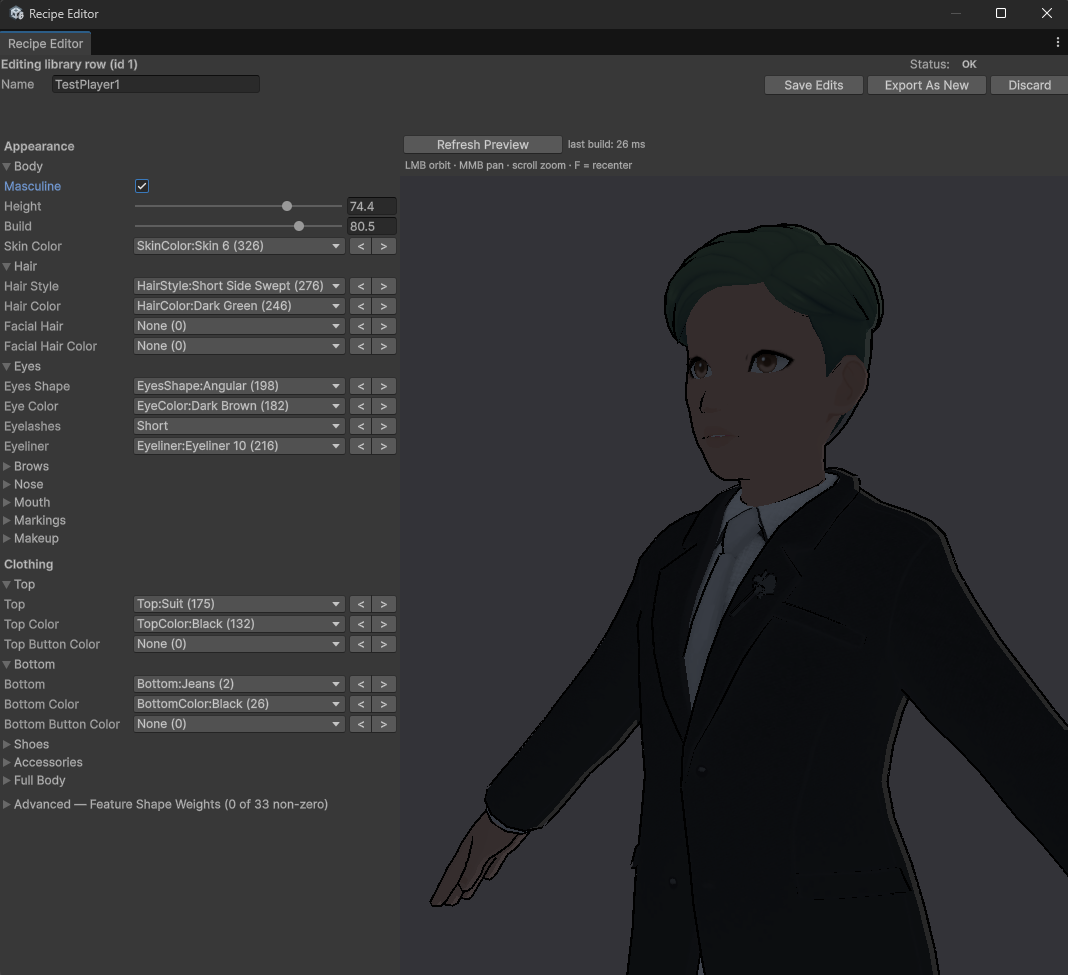
This update also unlocked something we've been wanting for a while: an in-editor NPC creation window. The team can now build new townsfolk and NPC presets visually in edit mode (as opposed to entering play mode and using the player-side character customizer to create a new NPC). Human characters now take less time to create, which means more variety in the world without the same cost in development time.
Here’s a look at the new character customization editor window. This window spits out character customization presets which we can plug into a human NPC to give them any look easily.
Combat-effects system: We’ve completely rearranged how we handle combat effects like poison, burn, stuns, etc.
Previously, abilities, passive effects, status conditions, and held-item effects each lived in their own little system with their own rules. Adding a new passive ability often meant touching three or four different systems, and held items couldn't really do anything interesting without dedicated work for each one.
We've now unified all of that under one combat-effects pipeline. Damage, healing, knockback, lifesteal, damage-over-time, healing-over-time, area-of-effect, status conditions, and crowd-control are all expressed the same way and can listen for the same triggers. Effects can stack, expire, get cleansed, or chain off each other, with safety rails to keep interactions from spiraling.
For players, the practical payoff is that we can now create dozens of new unique passive abilities and held items without creating new work each time. Expect to see this list grow quickly in the future.
Cooking ties into combat: While we were in there, we gave the cooking UI a polish pass and wired it into the new combat-effects system. Recipes can now apply any of the same effects that abilities, passive abilities, and items can.
Combat stability: A lot of this update's polish came out of a behind-the-scenes effort to make combat easier to test. Combat logic can now run on its own in the background without the camera, animations, or visuals attached, which means we can run hundreds of combat scenarios automatically every time we make a change. We are now constantly increasing the amount of our codebase that can be automatically tested. If a code update accidentally shifts a knockback distance or a dodge i-frame window, we can catch it before it ever reaches a build. It's not a flashy feature, but it's the kind of improvement that pays off in fewer surprise bugs and faster iteration on the combat depth we talked about above.
As you can see, we're making meaningful progress toward Kindred Fates' Early Access release, and we want to share where things stand. A core part of that progress right now is ensuring our tools are fully up to date. Once the engine upgrade is complete, we'll be able to build and iterate faster than ever before. From there, our next milestone will be making sure everything we've built for the beginning of the story is working exactly as it should.
We know many of you are eager for a concrete timeline, and we genuinely wish we could give you one. What we can promise is that we won't commit to a date until we're confident it's one we can stand behind. Your trust matters more to us than a date that we might have to walk back. Thank you as always for your patience and support. We're building something we're really proud of, and we can't wait to share it with you.
Community
In case you don't know, we post weekly on Bluesky! Here's what we've posted in the last month:
Nyazen texture test https://bsky.app/profile/skymillstudios.bsky.social/post/3mmv33hr5zs2g
Terrain update https://bsky.app/profile/skymillstudios.bsky.social/post/3mmdec35o4223
Who’s the cutest Kinfolk? https://bsky.app/profile/skymillstudios.bsky.social/post/3mls42gd5u22b
Nyazen In-Engine https://bsky.app/profile/skymillstudios.bsky.social/post/3ml7f5zcwek2g
LeXICON
The full lexicon can be found here.
Build: A playable version of the game. We create new builds for QA to test new changes.
Codebase: All of the code that makes up the project.
LTS: Long term support. Unity versions that are supported with bug fixes and updates over long periods of time.
NPC: A non-player character.
Optimization: Making the code run more efficiently, so it takes less processing power to achieve the same effect.
Workflow: The sequence of steps someone follows to complete a task.
Thanks for stopping by! We’ll see you for our next newsletter on June 26th. Until then, take care!
