
Progress
We’ve come a long way on Nyazen’s model and animations this month! The majority of the rigging is done, except for the smaller details of the fur on their ears and sides of their face. We want to be sure that all of their animations are appropriately majestic, and there’s no achieving that without close attention to the finer details.
In the meantime, we have the beginnings of an idle animation to share! Please note that this is an early draft, and while it showcases Nyazen with open eyes, they will typically have closed eyes as seen in the concept art.
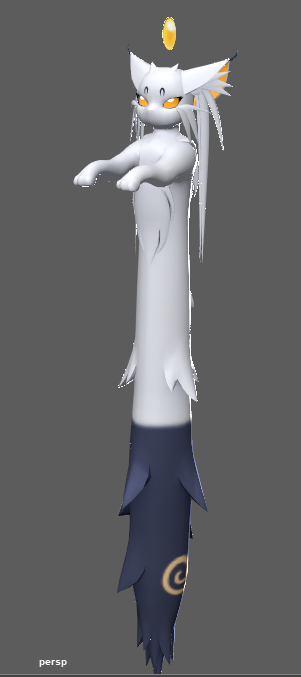
Due to Nyazen’s unique body type, they have a somewhat unorthodox (yet oddly familiar) T-pose! This is a full view of the model’s neutral pose:
Over the last two weeks we overhauled the game's dialogue backbone. The old xNode-based conversation graphs from the previous version of Unity have been retired in favor of a new, more concise system where writers and designers get to use a faster workflow. We also created a tool that easily ports all of our old xNode-backed dialogues over to the new system.
As part of our dialogue overhaul, we’ve added localization infrastructure. All dialogue text now flows through Unity Localization, with English as the default. We have yet to translate these dialogues, but the underlying framework that links dialogue nodes to different languages is now working!
We’ve also added functionality that allows dialogue to work with our Addressable system. Conversations now only load into memory when triggered and unload when they end, which will be a massive help for scene load times and memory.
We're now using a maintained vendor framework (NodeCanvas) instead of a hand-rolled graph engine (xNode), so from now on our custom code is limited to things that are specific to Kindred Fates.
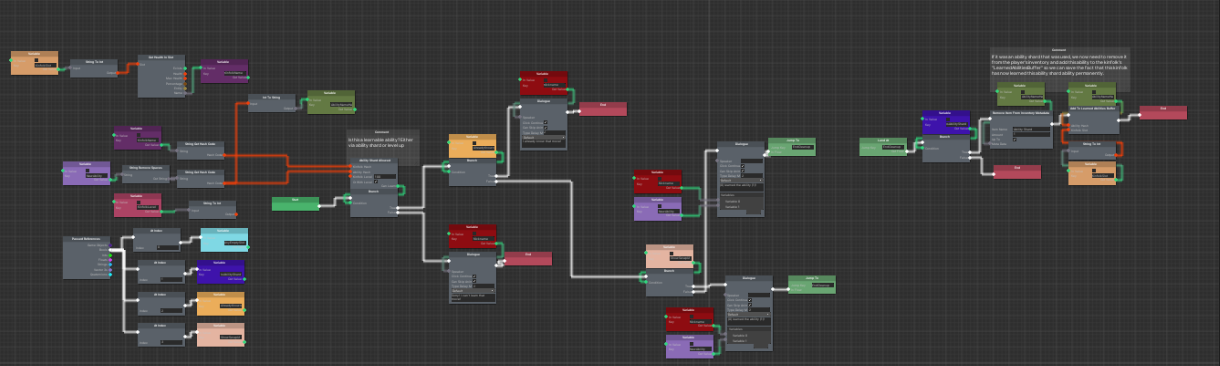
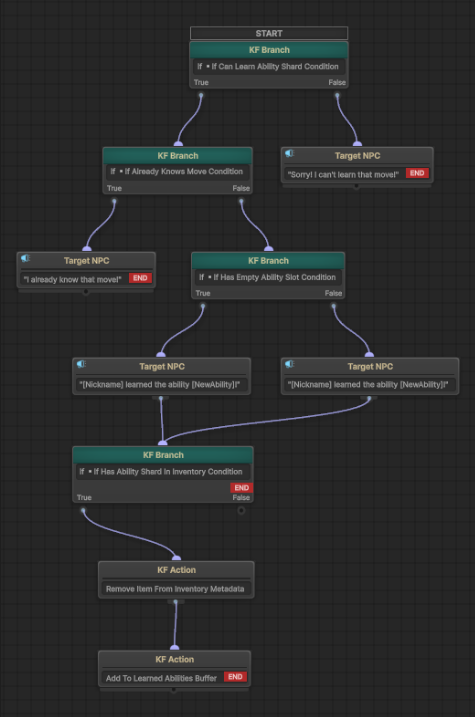
One of the most noticeable changes that came from this upgrade is the old system needed a dedicated node for every tiny operation. For example, we had separate nodes for the concept of "AND," “OR,” "NOT," etc., meaning graphs got crowded fast. The new system uses a blackboard for reusable variables that greatly reduces the number of nodes in each dialogue graph.
Here's a before and after of our dialogue graph that plays when learning a new ability via an ability shard or leveling up. Believe it or not, these two graphs do the same thing!
Before:
After:
Community
In case you don't know, we post weekly on Bluesky! Here's what we've posted in the last month:
Happy Earth Day! https://bsky.app/profile/skymillstudios.bsky.social/post/3mk5aim45wk2k
Nyazen’s Model Size https://bsky.app/profile/skymillstudios.bsky.social/post/3mjl7urxn7k24
Easter Wishes https://bsky.app/profile/skymillstudios.bsky.social/post/3mj23mgyyjc2o
“New” Discord Icon Art https://bsky.app/profile/skymillstudios.bsky.social/post/3mihzcz26t22g
LeXICON
The full lexicon can be found here.
Addressables: The framework Unity provides that allows developers to decide what assets are currently loaded into the computer's memory.
Optimization: Making the code run more efficiently, so it takes less processing power to achieve the same effect.
Rigging: Giving a character model a “skeleton” with joints that animators can move around to create animations.
Workflow: The sequence of steps someone follows to complete a task.
xNode: The software we used to use for handling our dialogue implementation.
Thanks for stopping by! We’ll see you for our next newsletter on May 29th. Until then, take care!
